White Nights
I really have such a love for short stories. I envy the way authors, like Edgar Allen Poe, are able to weave and stretch such extraordinary sentences and compel them together so well that they need no extra pages. But here, in White Nights, Dostoyevsky delivers the same sort of brilliance. The conversations shared between the protagonists are filled with such innocent words but are said with such depth, it never reads as simple.
Fydor Dostoyevsky
1847
The narrator remains unnamed and while that brings a sense of mystery that we all love, he, himself, is not a mystery. Throughout the story it seems he spills his words as fast as a tipped glass of water. Yet we never learn his name, only his deepest desires, loneliness and his yearning heart. Set in St. Petersburg, the story takes place over only four nights and one morning. The narrator's introduction for us begins with him rambling to us as if we were old friends. He talks of his comfort and familiarity in the streets of St. Petersburg and exclaims to us how he knows the whole heart of the city. But his loneliness seeps through his descriptions of the world.
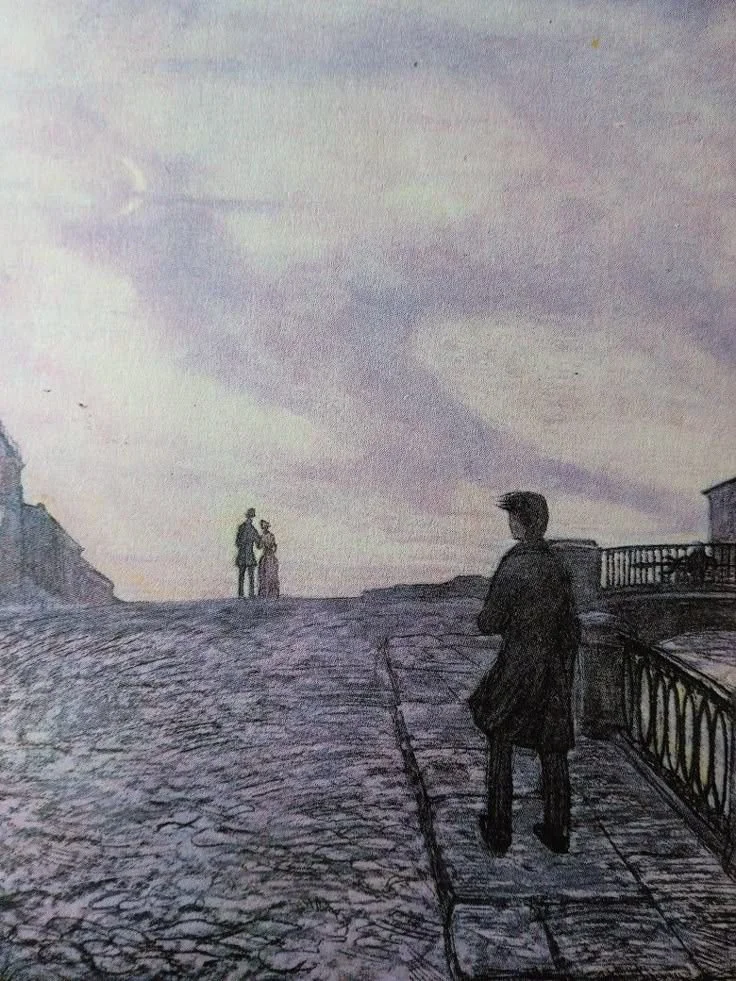
On the first night, the narrator is strolling alone on an evening walk when he stumbles across a crying woman. While hesitating to find the words to approach her, she stops her crying, adjusts herself and walks away. It was likely she was aware the presence of a man was nearby. The woman had fled across the street and fell in the sights of an unsafe man. Our narrator, still watching close by, is suddenly across the street at her hand when his instinct took over. When her safety had returned, she pleaded of her false thought of him and soon had her arm wrapped around his while he walked her home. Their first meeting had come to an end and she made him promise that they could be friends on the condition that he must not fall in love with her. But our lonesome narrator had no thought to ever leave her side after that.
Over the following days we learn oh such things about the two. I honestly have never wanted two characters to be together more than them. On the second night we learn the woman's name, Nastenka. He sings her name throughout the book like it's been his favorite song. Most of this story is written in dialogue which I actually really enjoyed. Their childlike conversations were filled with the profound innocence of saying far too much and not saying enough at all. Our narrator, as lonesome and isolated as he is in the city, bears his soul to Nastenka. And she listens in tune with the sound of his song and responds begging to know more. As if she knows not enough!
But his dear Nastenka harbors a secret. She holds another love for another man. Over the course of these four nights we see them fall in love, but not necessarily in your typical way. They grew this great bond as if they have shared eternities together. They pleaded to one another as if they had both been down on their knees begging to know the engravings on their skin. But the narrator knew of his fate, he knew it'd never last.
Though I was upset at the end, I admired the maturity their love held for one another. To be able to fall so quickly and so deeply in love, and to have the strength and ability to let that go is a love that comes from a soul. Their love might have been a fleeting memory but they both played an important role in one another's lives. I really loved the quote that was added at the beginning:
“And was it his destined part
Only one moment in his life
To be close to your heart?...”
-Ivan Turgenev
I think our narrator fulfilled his destined part and it seemed to be just enough.