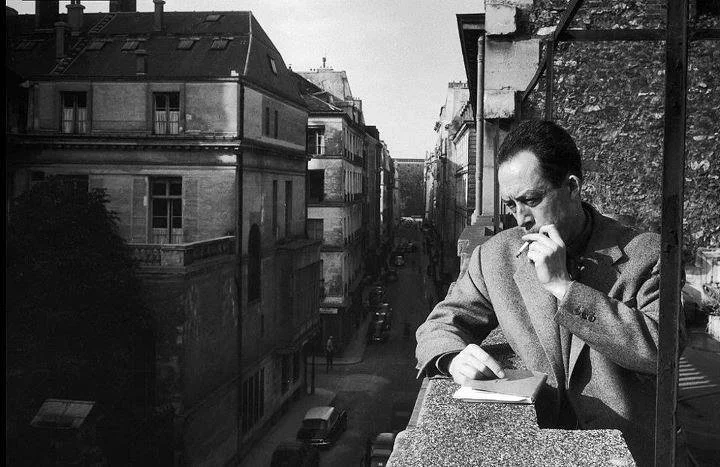
Albert Camus
The first book I read by Albert Camus was The Myth of Sisyphus and I will admit it took me a little bit to get through it. I had to start over many times just because I wasn't grasping it well enough or there were too many gaps in my reading days. When I finally read the book all the way through, I became infatuated with its idea. That is the idea of the absurd. I relate everything back to this idea and it has opened my mind very widely. So who was Albert Camus?
1913 - 1960
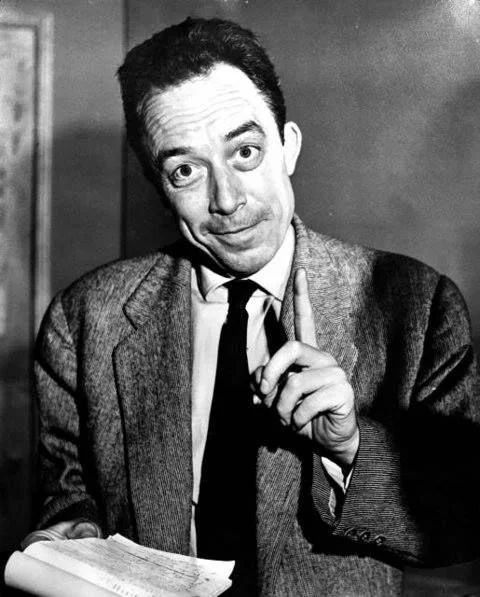
First of all to begin this, Camus was born on November 7, 1913. You'll never guess my birthday. Twins basically. Anyways, born on the seventh of November in the small village of Mondovi, located in the northeast region of French Algeria, Camus lived with his mother, father and older brother. He was raised and educated as catholic but he seemed to never necessarily show any belief in the supernatural. His father, Lucien Auguste Camus, was a military veteran and a wine shipping clerk while Helene (Sintes) Camus (his mother) was a housekeeper and part time factory worker. At less than one year old during WWI Lucien was called back for military service where he would end up passing away at the first battle of Marne. Which left Albert with his mother who was partially deaf and his older brother, Lucien Camus. Together they moved to Algiers and lived with his maternal uncle and grandmother in the working class district of Belcourt. The only thing Albert would ever know of his father was that after witnessing a public execution for the first time he became very ill which would lead to his lifelong opposition towards the death penalty.
Both him and his brother attended elementary school at the Local Ecole Communale where he was introduced to mentors that recognized and praised his intelligence. They showed him a whole new world of imagination but it was secondary school where he indulged in reading, developed a life long interest in literature, theatre and film, and learned Latin and English and even studied the bible where he learned to savor Spanish mystics such as St. Theresa of Avia and St John of the Cross and was slightly introduced to the thought of St. Augustine. Secondary school is what started his life long interest in literature, theater and film. Which is crazy knowing his mother and grandmother originally wanted him to quit school and start working at the age of 14, this changed when a teacher intervened. At age 17 he developed his first case of tuberculosis which would continue to affect him throughout his entire career. He was eventually ordered out of his home due to him being a ‘contagious threat’ to his family so he left to live with an uncle, Gustav Acault.
In June of 1932 he finished his Beacalauret degree and was already writing articles for a literary monthly called ‘Sud’. The following years would be interesting for Camus, between the years of 1933-37 he worked odd jobs, married his first wife (Simone Hie), got divorced, briefly joined the communist party and started a professional writing & theatrical career. He also enrolled at the University of Algiers and gained sociology & psychology certificates. In 1936 he became a co-founder of the Theatre du Travail, a professional acting company focusing on drama with a wing dedicated to political themes. He served as both a director and actor as well as also contributing scripts; he could’ve done a one man show. He would later re-organize the program and change the name to ‘Theatre de l’equipe’ - meaning theater of the team. This change created a new focus on classic drama and avant garde aesthetics.
Adding to his list of jobs, he joined the staff of a daily newspaper called “The Algier Republicain” in 1938. He worked as both a reporter and reviewer with his assignments covering anywhere from European literature to local political trials. During this time he would also publish his first two literary works - Betwixt & Between and Nupitals. I have yet to read either one but Betwixt & Between contains five semi-autobiographical and philosophical pieces while Nupitals is a collection of lyrical essays that explore both political and philosophical themes.
In December of 1940 Camus departed Lyons and moved to Algeria where he taught French History and Geography part time at a private school in Oran. This is the same time he was finishing the final touchups of his first novel The Stranger. Which is probably one of my favorite books. In 1942 he returned to France and started working for a newspaper a year later. This one was called The Clandestine Newspaper Combat and was considered to be the “journalistic arm and voice of the French Resistance movement”, a very fitting job for him. 1942 is also when he would publish his second novel, The Myth of Sisyphus, this one is most definitely my favorite one by far. Mostly because he explains the concept of the absurd in such a beautiful way. The Plague is when his writing reputation began to grow with The Rebel following in 1951 and The Fall in 1956. The fall is the last of his completed works and some considered it to be his “most elegant and most underrated” novel. During the fall of 1957, after the publication of Exile and the Kingdom which was a collection of six short stories, he was awarded the Nobel Prize for Literature. I find his reaction to this to be very sweet. While feeling incredibly honored about this he also felt his good friend and novelist Andre Malraux, was more deserving than himself. Adding to that he knew that the Nobel is given to those at the end of a career and he felt he was in the middle of it. Over the next two years he continued to write - publishing articles and still contributing to scripts, he directed and produced plays while influencing new concepts for film and television, he also took on a new leadership role in a new experimental national theater. While doing this all he was actively campaigning for peace and trying to find a political solution to save Algeria, which had been weighing more heavily on him than his ongoing experience with tuberculosis.
On the fourth of January 1960, Camus died from the result of a car accident. He was not driving at the time, his publisher Michel Gallimard was and suffered from terrible injuries. Camus was buried at a local cemetery in Lourmarin, where he and his family had been living for almost a decade. There was a beautiful eulogy written by Satre which I find to be truly touching :
Camus was many things, he studied and influenced the arts in ways that have still influenced our world but he describes himself with just one simple term ‘un ecrivain’ - a writer. Although, he was technically a philosophical writer if we were to go by his own definition. There were two things he listed in order to be a philosophical writer, the first you had to have conceived your own distinctive and original world view and two, you seek to convey that through fictional characters, images, events through a dramatic presentation rather than conveying through critical analyses. I admire how he describes himself with such a basic definition because it shows how humble he was about how much he contributed. I feel like it also plays into his ideology in terms of not overwhelming himself with the labels of the world. Camus has taught me that death is inevitable and you will always be racing time but if you run with time rather than against it - if you choose to recognize the chaos of the race that is the result of true freedom.